· 8 min read
Bullet journal: how it works and how to set one up
A bullet journal is a diary, to-do list and journal in one notebook. Here's how the index, the logs, the symbols and migration work.
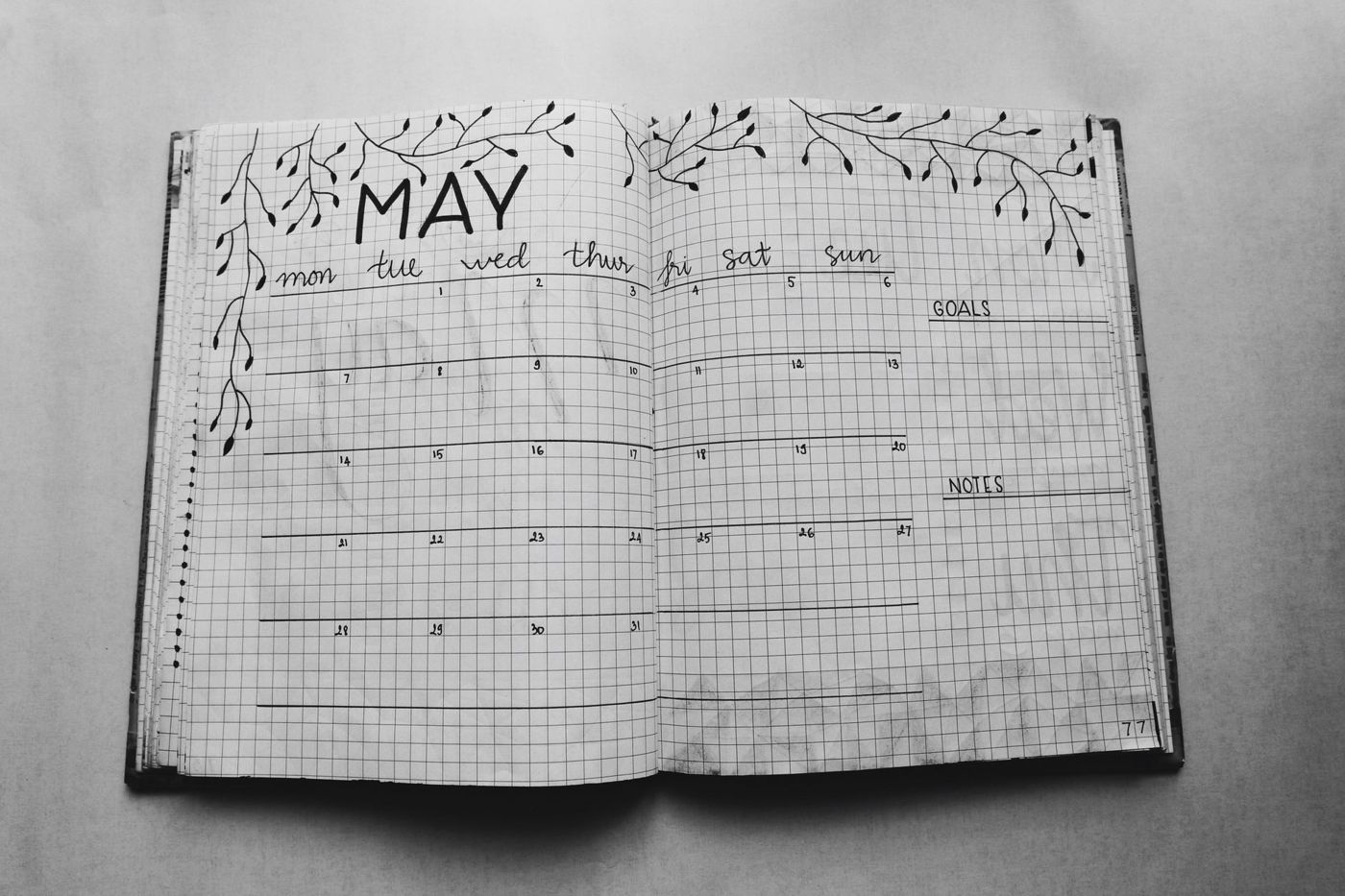
Online, a bullet journal often looks like a work of art: hand-lettered headings, watercolour flowers, cards stuck in. That makes it seem more complicated than it is. At its core, it's a simple system for getting everything in your head down on paper, in one notebook. Below you'll read how it works, which pages you need and how to start, even if the year is already half over.
What a bullet journal is
A bullet journal, often shortened to bujo, is a diary, to-do list, notebook and journal all at once. You don't need to buy a ready-made planner: you build the pages yourself, exactly the way you need them. The name comes from the bullet points you use to write everything down.
The system was created by Ryder Carroll, a digital product designer from New York. For years he had been looking for a way to keep a grip on his days. He was diagnosed with an attention disorder as a child, and ordinary diaries didn't work for him. In 2013 he put his method online, and it spread quickly. In 2018 his book The Bullet Journal Method came out.
Many people had in fact been working in a similar way for years. Carroll gave it a name and a fixed form.
The index
For the basics you only need four kinds of page. The first is the index, the table of contents for your book. Set aside the first two to four pages for it. Then number all the pages, if your notebook hasn't already done that for you. Every time you start a new page, add its title and page number to the index.
You don't need to list every day separately. It's about the pages you'll want to find again: the March monthly log, a reading list, the plans for a renovation. Many bujo users find they barely need the index during the year, but they're very glad of it later when they're looking for something in a full book.
The future log
The future log is your overview of the coming months. You divide one or two spreads (two facing pages) into boxes, one per month. Three months per page is usual. This is where you note things further ahead: a birthday in July, a holiday, a dentist appointment, the day your insurance needs renewing.
Put the future log straight after the index, so you can find it quickly. Give it plenty of space. You'll be less keen to use a page that's crammed full.
The monthly log
At the start of each month you make a monthly log. On the left-hand page, write the dates of the month in a column, with the first letter of the day next to each. That's where appointments and events go. The right-hand page holds a task list for that month.
Leave a narrow margin on the left, so you can add a symbol in front later. When you set it up, take a quick look at your future log: whatever is listed there for this month, you copy across.
The daily log
The daily log is where the real work happens. You write the date and, below it, everything that comes up that day: tasks, appointments, thoughts. Short, with a symbol in front.
Don't set up your daily logs weeks in advance. You can't know how much space a day will need. Simply start a new day below the previous one, or the evening before. Some people prefer to work with a weekly log. That isn't part of the basics, but of course it's allowed. If a week gets too full, you can still make a separate daily log for busy days.
Collections
Anything without a date gets a page of its own: a collection. Think of books you want to read, gift ideas, recipes to try or a habit tracker. Only start a page like this once you really have something to write on it, and add it to the index. With a tracker, start with one habit. Ten boxes a day is rarely something you keep up.
The symbols
The heart of the system is called rapid logging: noting things down quickly in short sentences with a symbol in front. The usual symbols are:
- a dot (•) for a task
- an open circle (o) for an event or appointment
- a dash (–) for a note, idea or thought
You change the dot in front of a task later, so you can see at a glance where things stand:
- a cross (x) over the dot: done
- an arrow pointing right (>): moved on to a later list
- an arrow pointing left (<): moved to the future log, because it only matters later
- a crossed-out task: no longer needed
You can also put an extra symbol to the left of the bullet. An asterisk (*) for something important and an exclamation mark (!) for a good idea are the best known. Use the asterisk sparingly. If everything is a priority, nothing is.
Keep events short and factual: “Signed contract”, not half a page about how you felt. If you want to say more, add a dash with a note underneath. In the same way, you can put small steps under a big task, slightly indented.
These symbols aren't set in stone. If a little square works better for you as a task, use that. Do put your own symbols on a key page at the front, though, so you keep using them consistently.
Migration
Migration sounds technical, but it's simply copying things out again. At the end of the month you go through all your open tasks. For each one you make a decision:
- Is it still needed and can it be done now? Copy it to the new monthly log and put a > next to the old one.
- Does it only matter later? Put it in the future log and give it a <.
- Does it no longer matter? Cross it out.
The copying out is exactly the point. Because you have to write each task out again by hand, you stop and think about it for a moment. If something isn't worth copying out, it probably isn't important either. That keeps your list honest and stops it growing endlessly long.
If you notice a task has already been moved on three times, ask yourself whether you really want to do it.
Do you have to decorate it?
No. A bullet journal is first and foremost a tool, not a work of art. Lots of people give up because they think every page has to look like the photos they see online. That was never the idea.
If you enjoy decorating, go for it. A strip of washi tape (thin, removable paper tape) to separate your months, a stamp for your headings or a few stickers make the book your own. You don't need to be able to draw for that. A tip that comes up often: set everything up for function first and only decorate afterwards. That way the decoration doesn't get in the way of your planning. And if your bujo becomes more a place for colour and collage than for lists, you'll find yourself drifting towards art journaling without noticing. That's fine too.
Which notebook and which pen
Any notebook will do. Still, a few things make it easier:
- Dot grid. Tiny dots instead of lines help you keep columns straight, but stay almost invisible. Squared or lined paper works too.
- A5 size. Big enough to work in, small enough to carry around.
- Numbered pages and a few index pages at the front save you work. Some notebooks are sold like that.
- Sturdy paper, around 80 to 100 gsm or more, so ink shows through less.
As for the pen: pick one you enjoy writing with. A black fineliner or gel pen is a popular choice. Always test a new pen on the back page first, to see whether it presses through or shows through. A ruler helps with trackers and tables, and a pencil is handy for sketching lines first or for writing page numbers in the index that might still change.
Think your handwriting is ugly? Write a little more slowly, or in capitals. It only needs to be readable.
Starting halfway through the year, or starting again
A bullet journal isn't tied to January. You can start on any day, because you only make the pages when you need them. Starting in June? Make a future log for the next six months, a monthly log for June and your first daily log. Done.
If you've stopped for a few weeks, there's nothing to catch up on. Turn the page, write today's date and carry on. Empty days aren't a mistake, and neither is a crossed-out word.
If your book is full, or you feel you've got stuck, start a new notebook. Only bring across what you really need: your open tasks, your future log and the collections you still use. At the start of a new year, double-check that you're copying the dates for the right year. The old book goes on the shelf, with its index as a summary of that period.
How to start today
Get a notebook and a pen ready and make these five pages:
- Two pages for the index.
- A key page with your symbols.
- A future log for the coming months.
- A monthly log for this month.
- Your first daily log.
Use it for a month without adding anything. Then take your time to see what works and what doesn't, and adjust it. That adjusting is part of it: after a few months, your bullet journal belongs to no one but you.
Questions about this topic
What is a bullet journal?
A planning system in an ordinary notebook, created by Ryder Carroll. It's a diary, to-do list, notebook and journal all at once, and you build the pages yourself.
What pages do you need in a bullet journal?
The basics are an index, a future log, a monthly log and a daily log. Anything without a date, such as a reading list or gift ideas, gets a page of its own: a collection.
What do the bullet journal symbols mean?
A dot is a task, an open circle an event and a dash a note. A cross over the dot means done, an arrow pointing right means moved on, and an arrow pointing left means moved to the future log.
What is migration in a bullet journal?
At the end of the month you go through all your open tasks. Anything still needed you copy to the new month, anything for later goes in the future log, and you cross out the rest.