 · 8 min read
Scrapbooking without photos: how to tell your story anyway
Only a few photos, no picture of that one moment, or children who won't pose any more? A scrapbook page works perfectly well without one.
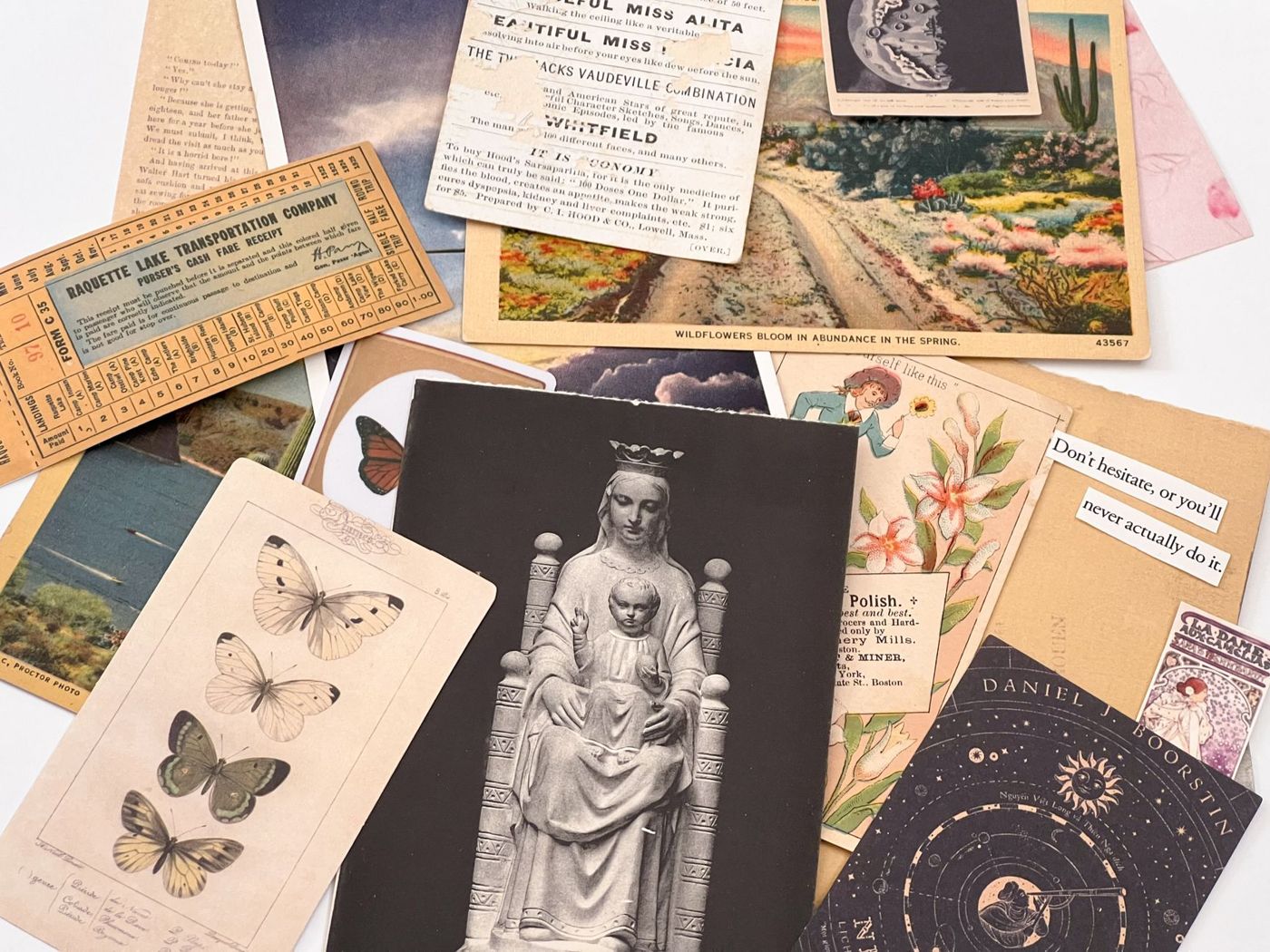
A scrapbook without photos might sound like a photo album without photos: empty. But it actually works the other way round. What sets a scrapbook apart from an ordinary album is the words, the tickets and the little things around the pictures. Take the photo away and the story is still there. And that is what you wanted to keep.
Does a scrapbook always need photos?
No. Scrapbooks existed long before everyone had a camera. In the nineteenth and early twentieth centuries, people mostly pasted in cuttings, prints, cards and letters. The photo as the centrepiece of the page only became the habit later on.
So a page without a photo isn't a stopgap. It's a different way of telling a story. Sometimes even a better one: a photo shows what something looked like, but not how it felt, what was said or why you wanted to remember it.
Start by thinking about what you want to capture. Is it an event, a period of time, a person or something that's on your mind? That will naturally tell you which materials get the starring role.
Let the words take centre stage
On an ordinary page, the journaling (the written text on your page) is often tucked away in a corner. Without a photo, it can be the centrepiece. Write it on a large piece of cardstock, the sturdy base paper scrappers use, and treat that block the way you would treat a photo: with a mat underneath, a strip of washi tape along the edge and a few embellishments (decorations such as stickers, buttons or die cuts) beside it.
Write out your text before you start on the layout. You often have more to say than you thought, and once you know how long it will be, you also know how much space you need. If it gets too much for the page, hide part of it in a little envelope or behind a flap.
A few formats that work well:
- A letter to yourself, to your child or to someone who is no longer here.
- A conversation you want to remember, written down just as it happened.
- A short description of an ordinary day, from getting up to going to bed.
- A saying that has become a family catchphrase, big as a title.
Your handwriting doesn't need to be beautiful. It's your own hand that makes the page personal. If you find that hard, you can also print your text, stamp it or use letter stickers.
Lists, tickets and drawings
A list is the quickest way to fill a page without a photo. It's easy to read and it looks calm. Think of ten things you ate this summer, the books you read this year, the songs that are always on in the car right now or the words your toddler says wrong.
Put the list on separate strips of paper, on a tag or on a journaling card. Alternating strips with small differences in colour give rhythm without making it busy.
Drawings do the same job as a photo, but in your own way. A simple line drawing of a cup of coffee, a map of your new street or a sketch of the table after a birthday is enough. If you can't draw, trace something, or let a child do it. A child's drawing is often the loveliest thing on the page.
Ephemera and objects in the starring role
Ephemera are the bits of paper that are really meant to be thrown away: tickets, receipts, little maps, labels, menus, leaflets, notes. Most of them have a date, a place or a price on them, and that's exactly how they tell where you were.
A few ideas:
- A concert ticket with the setlist written down from memory.
- A restaurant menu with what you all ordered.
- A train ticket with the reason for the trip.
- The name band from the hospital, a card from the visitors after the baby arrived.
- A paper bag from the bakery, folded flat.
Flat materials can go straight onto the page. For thicker objects, such as a keyring, a scrap of fabric, a button or a shell, it's better to use a clear pocket or an envelope, or to sew them on. That way your book stays closed and your pages stay flat.
Do keep in mind: receipts printed on thermal paper fade over time, and newspaper and cheap card can discolour and damage the page next to them. If you really want to keep something, scan or photograph it first and stick in the copy if you like. The original can then go in a little envelope on the back of the page. You can read more about keeping tickets, receipts and cuttings in a separate article.
Pages about feelings, wishes and favourite things
Not everything you want to remember is an event. Some of the loveliest pages are about who you are right now. In ten years' time, you won't remember what you ate every day, what you hoped for or what kept you up at night.
You don't need a photo for a page like that. A few topics to get you started:
- My favourite things right now: food, scent, colour, spot in the house.
- What I hope for in the year ahead.
- What I'm grateful for right now.
- What I find hard, and what helps.
- My home as it is now: the floor plan with what happens where.
Here, the paper and embellishments can carry the feeling. A calm page in soft colours for something dear to you, a busier one with lots of layers for a full and chaotic year. Write honestly about the less lovely times too. Those are the pages you'll recognise yourself in most when you read them back later.
When there's no photo of an event
Sometimes there simply isn't a photo. Your phone was at home, the moment was too short or it was something from long ago. Then there are other ways to find an image.
Afterwards, photograph what's still there: the place, the building, the bench where it happened. Or photograph an object that belongs to it, such as the dress, the ring or the little present. A postcard of the place or a map also works well as a background.
If it's about someone who is no longer here, choose something you connect with that person: a favourite song, a book or a dish. A print of the sheet music or a scanned page from the book makes a beautiful background. Print a record sleeve or book cover small, roughly photo size. Write down why this song or book belongs with that person: did he always sing along, did she read it again and again? Give each page one topic, so it doesn't get too heavy and a collection grows by itself.
If you use images from the internet, keep them for your own book. If you want to share the page later, check whether that's allowed.
When your children don't want their photo taken any more
Many parents notice it around the teenage years: the camera comes up and the child turns away. Forcing it doesn't work and mostly gives you grumpy photos. Luckily, you can capture a child well without them being in the picture.
- Their things: the shoes by the door, the desk, the pile of books next to the bed, the hockey stick. A photo like that says a lot about who someone is at that moment.
- Their own words: ask the same questions every year. What's your favourite food, who are your friends, what do you want to be when you grow up? Let them write the answers themselves. After a few years, their handwriting becomes a memory in itself.
- Their work: a school report, a certificate, a drawing, a ticket from a performance or match.
- What you see: write down what you notice about them, what they find funny, what they get worked up about.
You can also simply ask whether they'd like to choose a photo of themselves. A selfie they're happy with is fine too. Having a say in what goes into the book makes a big difference. A child who doesn't want to be photographed often does want to be seen, but on their own terms.
A few things to keep in mind
A page without a photo still needs a focal point. Choose one thing that draws the eye, such as the biggest block of text, a striking ticket or a title, and build around it. Keep the rest smaller and calmer.
Don't use everything at once. Three or four pieces of ephemera with a clear block of text read better than ten loose bits of paper with no connection. And don't forget the date: without a photo, you sometimes won't remember later which year something happened.
Start small. Choose one list, one ticket or one letter, and turn it into a page this evening.
Questions about this topic
Can you make a scrapbook page without photos?
Yes. A page can be built around words, a list, a drawing, a ticket or a small object. Scrapbooks existed long before photos were commonplace.
What is ephemera in scrapbooking?
Ephemera are bits of paper that are really meant to be thrown away, such as tickets, receipts, maps and menus. Most have a date or place on them, so they tell where you were.
What can I put in a scrapbook if my child won't have their photo taken?
Capture your child through their things, their own words and their work, such as a drawing or school report. You can also ask whether they'd like to choose a photo themselves.
How do you scrapbook an event when there's no photo of it?
Photograph the place or an object connected to it afterwards, or use a postcard or map as your image. Write down what happened and when.