 · 7 min read
Setting up a scrapbooking space, even without a craft room
A corner, a fold-down table or the kitchen table: with good light, a chair that fits and your tools within reach, you can scrap comfortably and safely anywhere.
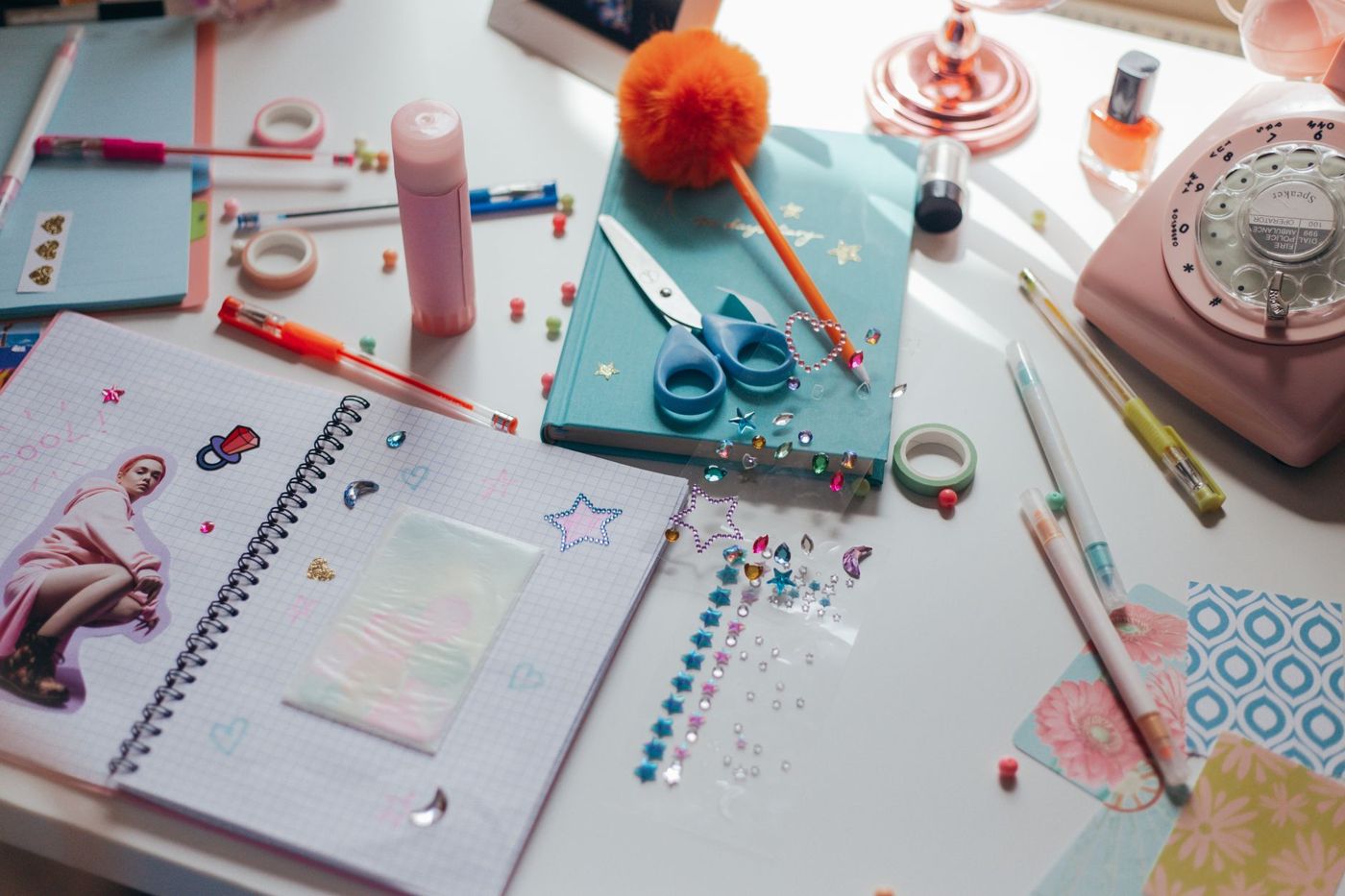
A craft room of your own is a lovely dream, but most scrappers work in a corner of the living room, in the loft or simply at the kitchen table. That's fine. A good scrapping space isn't about square metres. It's about light, a table that's big enough, a chair you can sit on for an afternoon and supplies you can grab without getting up.
What you need at the very least
Start with four things:
- a table that fits an open 30.5 x 30.5 cm album (a double page, 61 cm wide) and your cutting mat side by side
- good light, from the window or from a lamp
- a chair that suits the height of that table
- one fixed place for your supplies, even if it's just a crate or a drawer
Any table will do: an old desk, a cast-off dining table or a narrow console table. If you're short on space, a wall-mounted fold-down table is a clever solution. You fold it out when you start working and afterwards the space is free again. A table with a shelf above it also works well in a corner.
If you can free up a table just for your hobby, all the better. Then a half-finished page can stay where it is and you don't have to start by laying everything out each time. In a bedroom, on a landing or in an alcove there's often more room for this than you'd think.
A sheet of glass or a large cutting mat on your tabletop protects it from ink, glue and paint. Spilt ink wipes off glass with a cloth.
Light: by day and in the evening
Daylight is the best light to work in. You see colours as they really are and your eyes tire less quickly. So put your table by a window, with the light coming from the side. If you sit with your back to the window, your own shadow falls on your work. Bright sunlight straight onto your table creates harsh shadows and glare on glossy paper. A light curtain or a net curtain softens it.
In the evening and in winter there's little or no daylight. That's when a daylight lamp helps: a lamp with white, cool light that resembles daylight. Look out for a few things when choosing one:
- cool white light, around 5000 to 6500 kelvin, so colours don't turn yellow
- high colour rendering, often labelled CRI 90 or higher, so red and pink really look red and pink
- an arm you can swivel, so you can angle the light onto your work
- light that doesn't shine in your eyes
Place the lamp on the side opposite your writing hand. If you're right-handed, it goes on the left. That way your hand isn't working in its own shadow. And leave the ceiling light on too, so the contrast between your table and the rest of the room isn't too great.
Choose the colours for a page in daylight if you can. What seems to go well together under a warm lamp in the evening can look slightly different the next morning.
Tools within reach
A simple rule: what you use on almost every page stays within arm's length. What you need now and then can go in a drawer or on a shelf further away. Even having to walk a few steps means you'll reach for something a little less often.
Most scrappers keep these close by:
- paper trimmer and cutting mat
- scissors and craft knife
- glue and double-sided tape
- ruler and bone folder
- a few pens for writing
Put these in a pot or a rotating caddy on the table. A pegboard on the wall above your table is ideal for scissors, rulers and punches: you can see everything and your work surface stays clear. A magnetic strip from the kitchen can hold scissors too.
The space under the table is good for things you use less often. And put an extension lead somewhere you can reach without bending down, for your lamp and your heat tool.
Working at the kitchen table
If you work at the dining table, everything has to come off again quickly afterwards. That only works if your supplies have a fixed place to go back to.
- Use a three-tier rolling trolley. You wheel it to the table and afterwards into a corner or cupboard.
- Or keep a sturdy box or a bag with handles that always holds your basic tools.
- Make a project box or folder for what you're working on now: the photos, the paper you've chosen and the half-finished page. It closes up all in one go.
- Lay down a large cutting mat or an old tablecloth before you start, so scraps and glue splashes can be cleared away in one go.
Set aside five minutes at the end to tidy up. Snippets into a scrap tray, tools back in the box, the page in the folder. Then next time you won't start with a pile you can't face.
Sitting well during long sessions
An afternoon of scrapping easily lasts a few hours, and an ordinary kitchen chair isn't always made for that. You only notice it afterwards, in your neck and lower back.
A few things to look out for:
- Your feet are flat on the floor or on a footrest.
- Your elbows are roughly level with the tabletop, so your shoulders stay relaxed.
- You don't have to lean far forward to see your work. A sloped board or a thick book under your album helps.
- A small cushion in the small of your back makes a straight chair much more comfortable.
Some scrappers prefer to work standing up, for example at a high table or a kitchen worktop. Cutting is often easier standing, because you have a better view and more strength. Switching between the two is best.
Get up now and then. Fetch some water, look out of the window, have a stretch. Your eyes benefit from a moment of looking into the distance, especially after an hour of fiddly cutting.
Working safely with blades and heat
A craft knife is sharp and a heat tool for embossing gets very hot. A few fixed habits keep things safe.
With blades:
- Always cut on a cutting mat and always away from you. Hold the ruler with your free hand, with your fingers well away from the cutting line.
- Use a metal ruler, or one with a raised edge, so the knife can't slip over the edge.
- Replace a blunt blade in good time. A blunt blade needs more force and is more likely to slip.
- Put the cap back on straight after use, or retract the blade.
- Don't throw old blades away loose. Put them in a closed jar or wrap them in tape.
With heat:
- Put a heat tool down on a heat-resistant surface, never on a pile of paper.
- The tip stays hot for a while. Let it cool down before you put it away.
- The same goes for a glue gun: put it in its stand and keep the cable away from the edge of the table.
- Unplug it after use.
If you work with spray cans, alcohol markers or strong-smelling ink, open a window. And if there are children in the house, keep blades, punches and small parts out of their reach. Store them up high or in a drawer they don't open.
Make it your own
A place you like sitting in is a place you'll use more often. Hang a few of your own pages on the wall, or stand a finished album upright on a shelf. A pinboard with cards you've been given by others makes it personal straight away. Change it now and then, so it keeps surprising you.
It doesn't have to be big or new. A table someone gave you, a second-hand chest of drawers and a good lamp are enough to turn a corner into a place that makes you want to get started.
Questions about this topic
What do you need to start scrapbooking?
A table, good light, a chair that suits the table and one fixed place for your supplies, even if that's just a crate or a drawer.
What is the best lamp for scrapbooking in the evening?
A daylight lamp with cool white light of around 5000 to 6500 kelvin and high colour rendering (CRI 90 or higher). Place it on the side opposite your writing hand.
How do you scrapbook at the kitchen table without making a mess?
Use a rolling trolley or a box that always holds your basic tools, and a project box for your half-finished page. Set aside five minutes at the end to tidy up.
How do you use a craft knife and heat tool safely?
Cut on a cutting mat, away from you, and use a metal ruler. Put a hot heat tool down on a heat-resistant surface, let it cool before you put it away and unplug it.